Your Butcher Isn't Butchering Your Margins — The Menu Architecture Is
A 2.4 kilo rawas at ₹1,400 a kilo. The invoice says ₹3,360. You pay it, you file it, and that ₹1,400 goes into your costing sheet as the price of rawas.
Then your chef takes it apart. Off come the head, the skin, the belly, the pin bones and the tail. What's left is maybe 1.2 kilos of fillet you can actually serve.
Your real cost is ₹2,800 a kilo. Not ₹1,400.
What the invoice saysWhole rawas
Weight bought
2.4 kg
Invoice
₹3,360
Cost per kilo
₹1,400
Dish costed at 34%
What reaches the plateUsable fillet
Weight after butchery
1.2 kg
Same invoice
₹3,360
Cost per usable kilo
₹2,800
Really running near 68%
Half the fish comes off on the board, so every gram you serve costs twice what the invoice suggests.
Which means the signature dish you believe runs at 34% is running closer to 68%, and has been for as long as you've had it on the menu.
Your supplier charged you fairly. The loss happened on your own board.
Why this is a premium problem specifically
A neighbourhood restaurant has a food cost problem in its recipes — loose portioning, cheap substitutions, a cook who adds oil by feel.
You don't have that problem. Your recipes are written, your chef is precise, your portions are weighed. And because everyone knows a serious kitchen runs a higher food cost than a casual one, most premium operators stop interrogating the number at all. 34 percent sounds correct, so nobody asks what's inside it.
Precision in the recipe doesn't stop the leak. It just moves it upstream.
But you handle ingredients that cost ten times what a casual kitchen touches. At that level, the money doesn't leak through the recipe. It leaks before the dish is ever cooked.
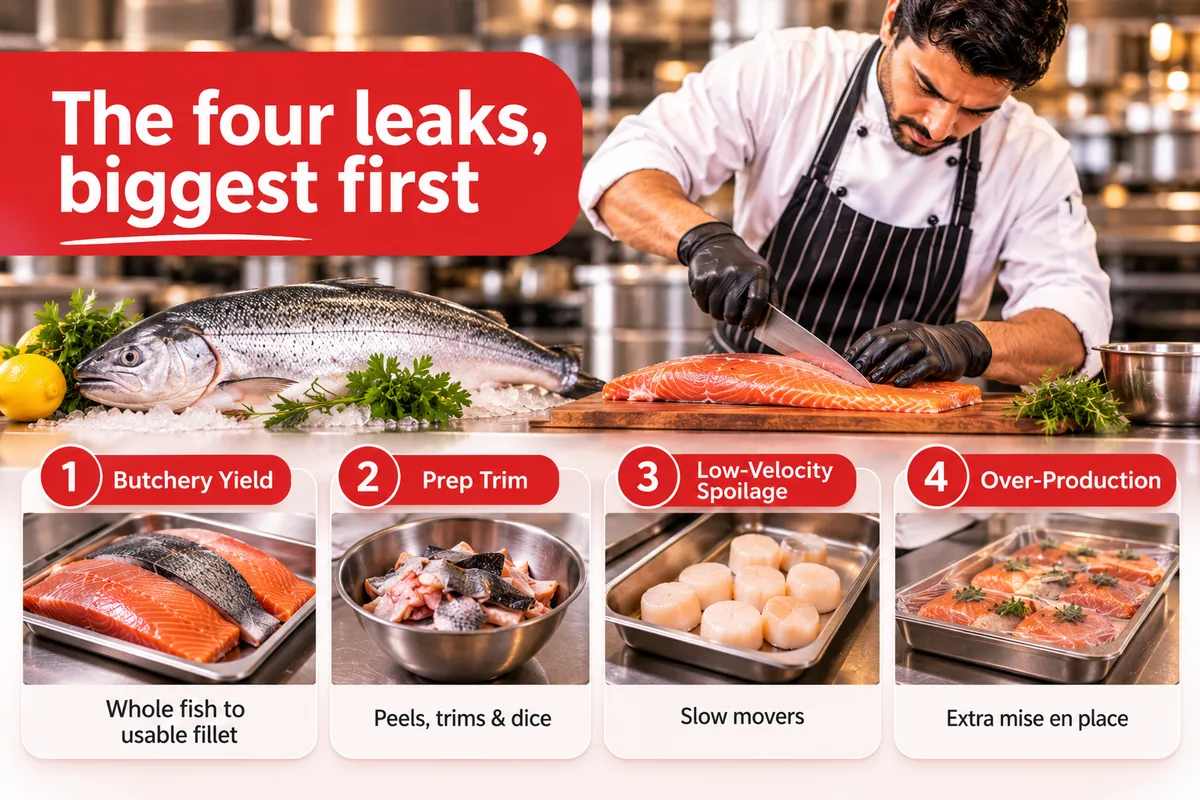
The four leaks, biggest first
Butchery yield
Whole fish, lamb racks, duck, tenderloin. The invoice price is fiction and the only honest number is cost per usable gram. Most kitchens work it out once, at the beginning, and never again — even after the supplier changed, or the size grade shifted, or a new commis started breaking down the fish.
Prep trim
Everything you peel, pick, trim and dice before service starts. A kitchen at your level throws away a quarter of what it buys by design. That quarter is in your ingredient cost whether you count it or not.
Low-velocity spoilage
The scallop dish sells six times a week. You carry scallops for the whole week. The true cost of every scallop you sell includes the ones you didn't, and on a slow-moving premium item that can add 20 to 30 percent. This is the one that makes chefs go quiet.
Over-production
Mise prepped for a Friday that never showed up.
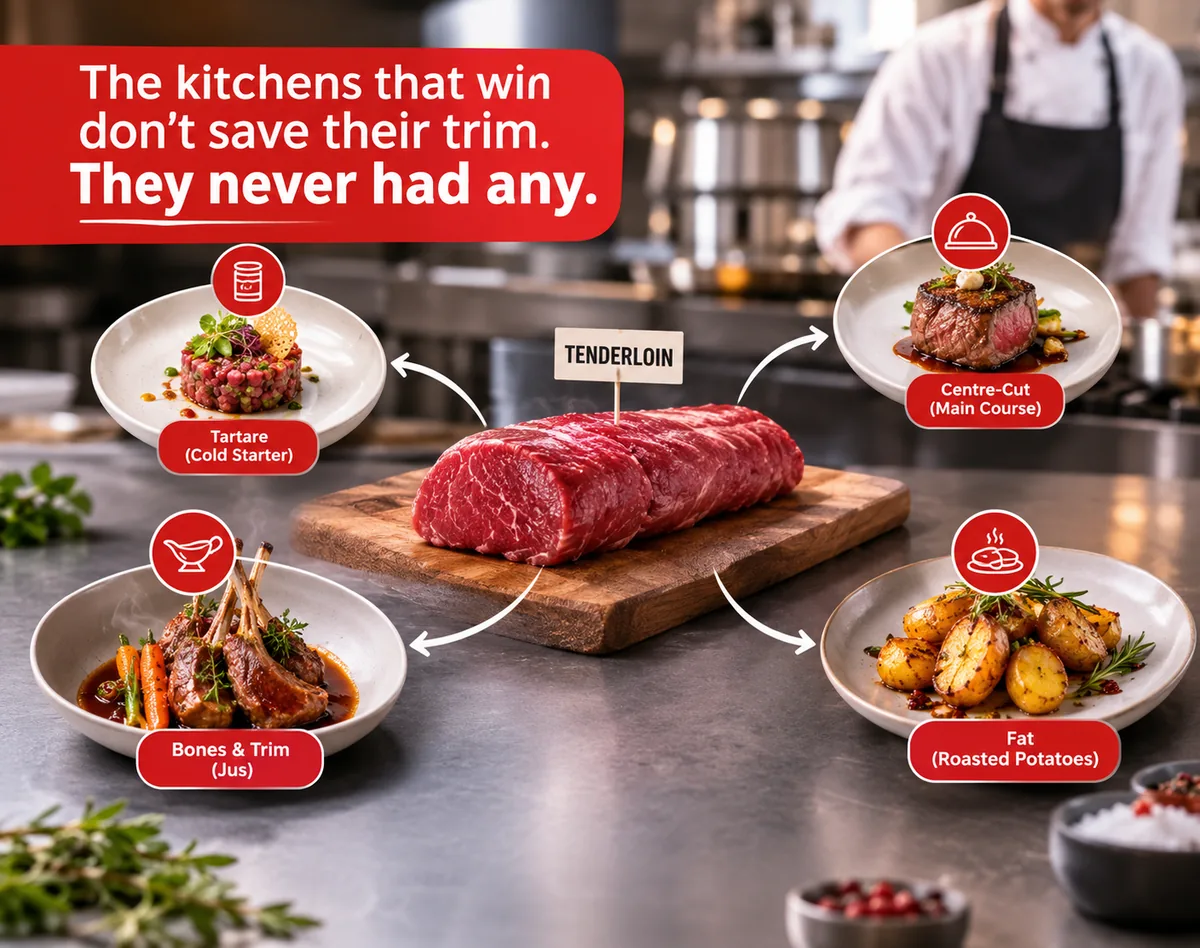
The kitchens that win don't save their trim. They never had any.
There's a difference between rescuing offcuts and designing a menu that doesn't produce them.
One rawas arrives.
The filletThe main course
Belly and trimThe tartare on the cold starter
Head and bonesSimmered into the stock for a prawn bisque at the other end of the menu
Skin and fatRendered down for the potatoes
Four menu items, one invoice, nothing rescued — because nothing was ever thrown out in the first place. That isn't thrift. That's how the menu was built.
The same idea works for meat: one tenderloin, four places on the menu.
Most menus aren't built that way. They're built dish-by-dish, each one starting from a blank page and a shopping list, and the gap between what arrives and what gets plated is the price of that approach.
It's also why the best kitchens run lower food costs without serving worse food. Nobody shrank a portion. Nobody downgraded an ingredient. The same rawas simply appears in four places instead of one.
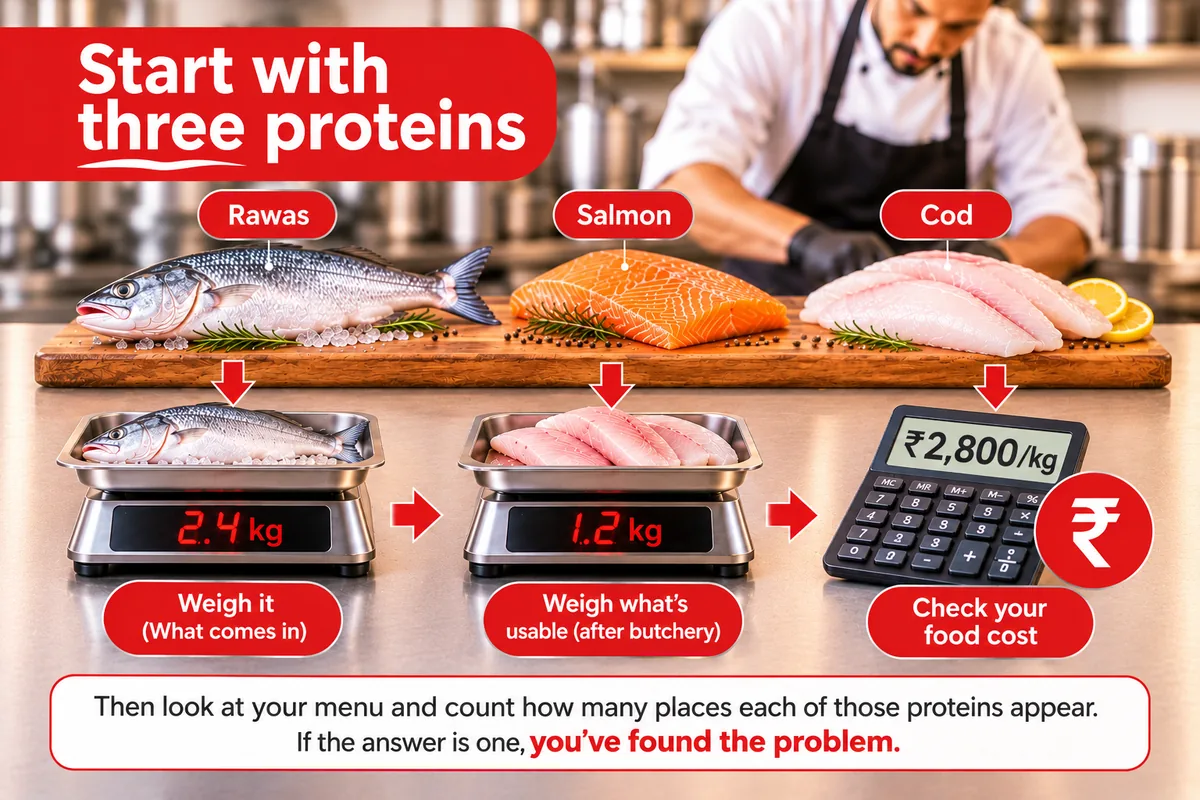
Start with three proteins
Take your three most expensive proteins.
Weigh what comes in the door. Weigh what's actually plateable after butchery.
Put both numbers into the food cost calculator and look at what you're really paying per usable kilo.
Then look at your menu and count how many places each of those proteins appear.
If the answer is one, you've found the problem.
Free tool from HTI
Find Your Real Cost per Usable Kilo
Weigh it in, weigh it plated, and let our Free Food Cost Calculator show you what your signature dish really runs at.
Butchery yield is the share of what you buy that you can actually serve once the head, skin, bones, belly and trim come off. A 2.4 kilo rawas that leaves 1.2 kilos of fillet has a 50% yield.
How do you work out cost per usable kilo?
Divide what you paid by the weight that is plateable after butchery, not the weight on the invoice. ₹3,360 for a fish that leaves 1.2 kilos of fillet is ₹2,800 per usable kilo, double the ₹1,400 invoice price. The food cost calculator does this for you.
How does menu architecture lower food cost?
By planning dishes around the whole ingredient instead of one cut. When the fillet, the trim, the bones and the fat each go into a different dish, one invoice pays for four menu items and nothing is thrown out — without shrinking a portion or downgrading an ingredient.
Why do premium restaurants miss this?
Because a higher food cost is expected in fine dining, a number like 34% sounds right and nobody checks what's inside it. With ingredients that cost ten times more, the money leaks before the dish is cooked: in butchery yield, prep trim, slow-moving spoilage and over-production.