Your Menu Is a Cricket Team. And Maybe Four of Your Players Shouldn't Be Playing.
Two dishes. Last month one sold 185 portions, the other sold 22. Which would you drop?
Almost every owner picks the 22. Maybe that’s not the right answer.
The 185-portion dish was veg hakka noodles, earning about ₹118 a portion — ₹21,830 for the month, with the kitchen going flat out. The 22-portion dish was prawns in burnt garlic at ₹265 a portion. Only ₹5,830, but your team didn’t upsell it. If they moved it to just 60 portions, that’s ₹15,900, with no added staff or new equipment and ingredients.
The bestsellerVeg hakka noodles
Portions sold
185
Earned per portion
₹118
Month
₹21,830
Kitchen flat out
The one you'd dropPrawns in burnt garlic
Portions sold
22
Earned per portion
₹265
Month
₹5,830
Upsold to 60 portions
₹15,900
No added staff or equipment
Also, where you position it on your menu card affects the sales — think of the menu card as real estate. Some floors and locations are more valuable than others.
This profit gap is sitting in your restaurant right now. Maybe it’s the prawns. Maybe it’s the mutton. Maybe it’s a pasta nobody can pronounce. Menu engineering is the way to uncover the man of the match.
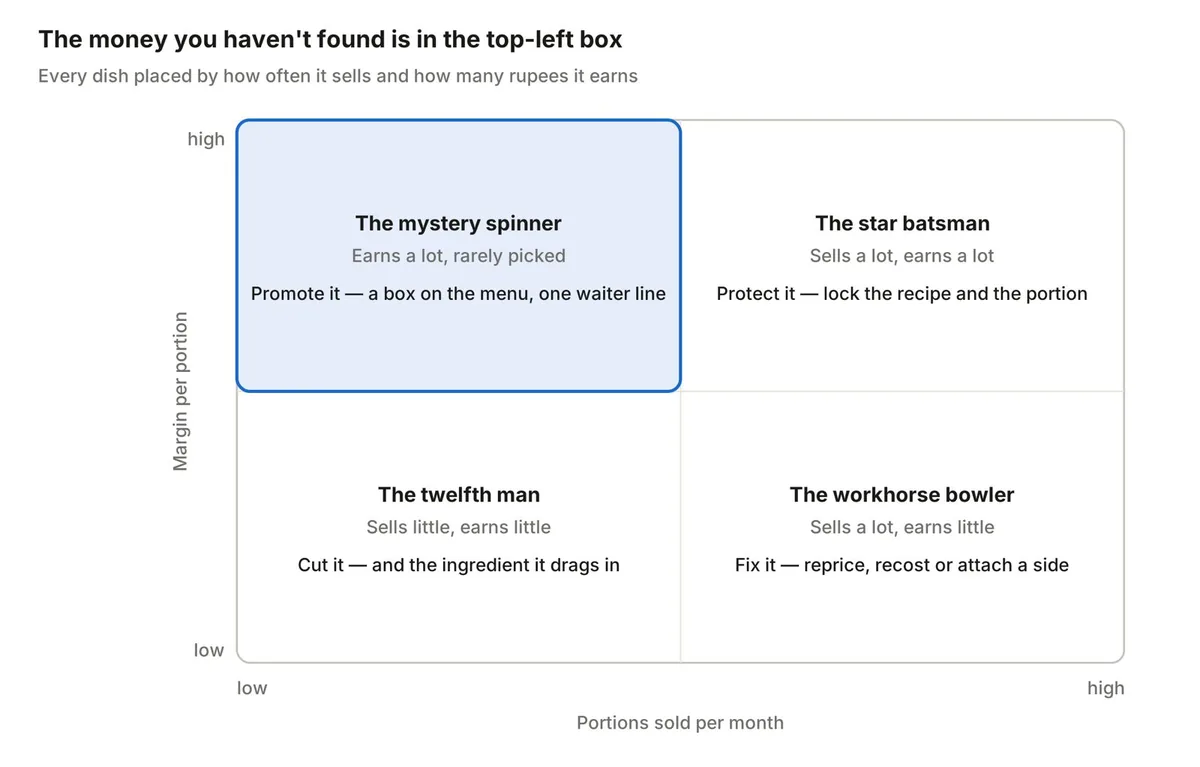
Two numbers, four boxes
Take the last month’s bills and your top 20 dishes. For each, note down two aspects: portions sold, and rupees earned after food cost. Rupees, not percentage — a dish at 25% food cost on a ₹200 portion earns ₹50, while 40% on a ₹400 portion earns ₹160.
Average both columns. Those two averages are your dividing lines. Now every dish is one of four players.
The Star Batsman
Sells a lot, earns a lotProtect it
The star batsman sells a lot and earns a lot. Maybe it’s your chilli chicken. Don’t touch it. Lock the recipe and ensure portion sizes are controlled. Position it to the top right hand side of your menu page where guests eyes land first.
The Workhorse Bowler
Sells a lot, earns littleFix it
The workhorse bowler sells a lot and earns little. Maybe it’s your naan, maybe the fried rice. It feels like a bestseller because the kitchen never stops making it. A ₹10 rise on 900 naans is ₹9,000 a month and nobody walks out. But rice and naan are somethings everyone will look for and order, so position it at the bottom left of the menu.
The Mystery Spinner
Earns a lot, rarely pickedPromote it
The mystery spinner earns well but rarely sells. Gets you the best margin, but it’s sitting on page three in the same font as the rest of the dishes. That’s a promotion problem. Place it in a box to highlight it and give your waiter a one-liner to help it sell while the table is still deciding.
The Twelfth Man
Sells little, earns littleCut it
The twelfth man does neither. Usually a dish from 2009, dragging along one ingredient you buy only for it, which then sits in the fridge and spoils. Cut it, and watch that ingredient leave your purchase list too.
The four players on one grid: rupees earned per portion against portions sold.
Then change two things, not twelve
Promote one mystery spinner. Cut one twelfth man. That’s month one. If you implement these two strategic changes, they will beat twelve ineffective ones.
One more pass
Run this study twice — one for dine-in and the other for delivery. A ₹420 pasta earning ₹325 in your dining room earns about ₹165 on Swiggy once commission, your discount and leak-proof packaging are factored in. The same dish is a star in one room and a workhorse in the other.
Dining room₹420 pasta
Menu price
₹420
Earns
₹325
Star batsman
On SwiggySame ₹420 pasta
Menu price
₹420
Earns about
₹165
Workhorse bowler
Delivery earnings after commission, your discount and leak-proof packaging.
Most owners run one menu, one price, without realizing they are two completely different businesses.
Your bills already hold the answer. One Monday with a calculator, and you’ll know which four players shouldn’t be on the field.
Know What Every Dish Really Earns
Sorting your menu starts with the rupees each dish earns after food cost. Our Food Cost Calculator works it out in minutes.